
The Dry January Lie No One Talks About

The Dry January Lie No One Talks About
Let me tell you something nobody's saying about Dry January: January 1st isn't magic, and you're not broken if you wake up that morning still wanting a drink.
Every year, millions of people decide they're doing Dry January. They post about it. They get the apps. They tell their friends. And then somewhere around January 8th, they're drinking again and feeling like shit about themselves.
Here's why: everyone's treating Dry January like a diet. Like if you just have enough willpower and download the right tracker app, you'll white-knuckle your way through 31 days and emerge transformed on the other side.
That's not how alcohol works. That's not how your brain works. And that's definitely not how lasting change works.
The Part Nobody Warns You About.
You know what happens around day 3 to day 7 of not drinking? You feel worse. Not better. Worse.
Your sleep is terrible. You're irritable as hell. You're bored out of your mind. Every evening feels like it lasts 96 hours. You're watching the clock thinking "this is what I'm supposed to want?"
This is the part where most people bail. Because nobody prepared them for this. All the Dry January content is about feeling amazing and sleeping great and having so much energy. They don't tell you that first you have to get through the part where your dopamine-starved brain is basically throwing a tantrum because you took away its favorite toy.
Your brain got used to that alcohol hit. It adjusted. And now you've removed it and your brain is like "excuse me, what the fuck?" It takes time for your neurochemistry to recalibrate. Days 3-7 are typically the worst of it. If you don't know that's coming, if you think something's wrong with you for feeling this way, you'll convince yourself that not drinking isn't working and you'll pour a drink to feel normal again.
The "Just One Month" Trap
Here's another thing nobody mentions: doing Dry January without any plan for February 1st is actually setting yourself up to drink more than you did before.
Think about it. You spend 31 days whiteknuckling it, telling yourself "I just have to get through this month." You're not learning anything about why you drink. You're not building any tools for managing cravings or boredom or stress. You're just... not drinking. And counting down the days.
Then February 1st hits and you're like "I did it! I can drink again!" And because you spent a whole month feeling deprived, you go harder than you normally would. You've "earned it." You "proved you're not an alcoholic." And now you're back to drinking, except you feel even worse about it because you know you can stop, you just don't want to.
That's not a Dry January problem. That's a "treating sobriety like a cleanse" problem.
What Actually Works (Spoiler: It's Not Willpower).
You don't need more willpower. You need better tools.
You need a protocol for when a craving hits at 7pm on a Tuesday and you've had a shit day and your brain is screaming that a drink would fix everything. You need a framework for making the decision not to drink in the moment when that decision feels impossible. You need strategies for the social situations, the boredom, the stress, the celebration.. all the things that used to involve alcohol.
Most people try to Dry January without any of this. They think wanting it badly enough is the strategy. It's not.
Here's what I mean by actual tools:
A craving protocol. Not "just distract yourself" or "drink water instead." An actual step-by-step system for what to do when your brain is telling you that you need a drink right now. Something that addresses what's actually happening in your brain and body, not just surface-level substitution.
A decision-making framework. Because the hardest part isn't the physical craving.. it's the mental negotiation. It's your brain coming up with very convincing reasons why tonight is different, why one drink would be fine, why you've earned it, why you deserve it. You need a way to short-circuit that conversation before it even starts.
A plan for dealing with emotions without numbing them. This is the big one. If you've been using alcohol to manage stress, anxiety, boredom, loneliness, anger.. all the uncomfortable feelings.. then taking away the alcohol without addressing what you were using it for is just torture. You need other ways to process that stuff.
A structure that's actually manageable. Thinking about 31 days is overwhelming. Breaking it into weeks, with specific focus areas for each week, makes it digestible. Week one is about getting through the physical adjustment. Week two is about handling boredom and routine. Week three is navigating social situations. Week four is figuring out what comes next. That's a system. That's something you can follow.
The Real Question You Should Be Asking
Here's what most people don't realize until they're a couple weeks into Dry January: this isn't really about whether you can not drink for a month.
It's about figuring out what role alcohol is playing in your life. What you're using it for. What it's actually doing versus what you think it's doing. And whether you want to keep that relationship or change it.
Some people get to the end of Dry January and realize they feel so much better that they want to keep going. Some people realize they can drink moderately and be fine. Some people realize they need to quit for good. All of those are valid outcomes, but you won't get to any real answer by just gritting your teeth for 31 days and then going back to exactly how things were before.
Dry January only works if you use it as a learning experience, not an endurance test.
Stop Setting Yourself Up to Fail
If you're going into this thinking that January 1st is when everything changes and you just need to be strong enough to make it through, you're already setting yourself up to fail.
Change doesn't happen because the calendar flipped. It happens because you built a system that works for your actual life, not some Instagram version of sobriety where everything is green smoothies and morning runs.
You need realistic expectations (it's going to suck before it gets better). You need actual tools (not motivational quotes). You need a plan for what happens after January (because that's when the real work starts). And you need to stop treating this like a punishment you have to endure and start treating it like information you're gathering about yourself.
That's how you make Dry January actually mean something.
That's how you don't end up right back where you started on February 1st, wondering why you bothered.
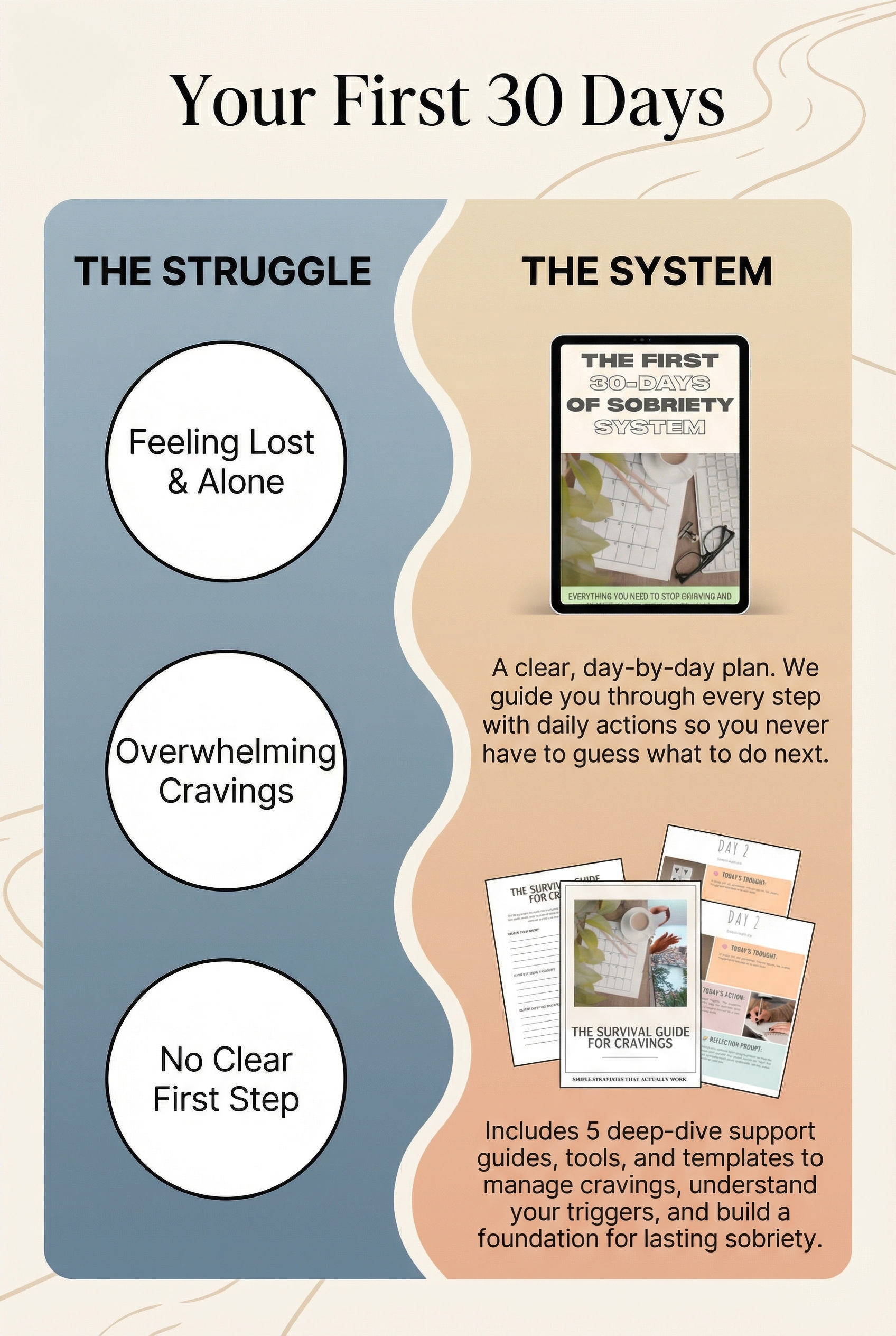
If you’re done with “Day One” over and over again, stop relying on willpower. The first 30 days are the hardest.. and that’s exactly what my 30 First Days of Sobriety System – All In One is built for. Clear daily steps. Proven tools. No guesswork. If you’re serious about quitting, follow a system that actually works.
Get it here.
Ready to Support Your Healing?
Start your journey with my free guide, Reboot Your Environment, and learn how to create a space that supports your peace, focus, and recovery.
Because the science is clear, when your environment supports your brain, staying sober feels easier.